top of page

0.1. Basic Anatomy (I)
Introducing the Basics
Anatomy is the study of the structure of the human body. As such, we use a lot of terms that describe the location of various structures (e.g. organs, tissues, blood vessels). These anatomical terms are relative – this means that we describe one structure as lying relative to another structure. For example, the spinal cord lies behind the heart. A second example would be: the brain lies above the stomach. We can flip these examples around too. The heart lies in front of the spinal cord, and the stomach lies below the brain. All four of these statements are correct.
Relative terms are not much good as described above and let me give you an example to explain why. Does the heart always in front of the spinal cord. The answer is yes, if you are standing upright and looking at a human being from behind. The answer is no if the human is lying down on a bed – in this case, the heart actually lies above the spinal cord. This may seem very nit-picky, but this problem is the reason for such precision and care in anatomy. Anatomy uses two methods together to overcome this problem.
Relative terms are not much good as described above and let me give you an example to explain why. Does the heart always in front of the spinal cord. The answer is yes, if you are standing upright and looking at a human being from behind. The answer is no if the human is lying down on a bed – in this case, the heart actually lies above the spinal cord. This may seem very nit-picky, but this problem is the reason for such precision and care in anatomy. Anatomy uses two methods together to overcome this problem.
- Precise positional anatomical terms (e.g. ‘anterior’ means ‘in front of’; ‘posterior’ means ‘behind’).
- Anatomical position – every positional anatomical term refers to the body only when it is in a specific position, called ‘the anatomical position’.
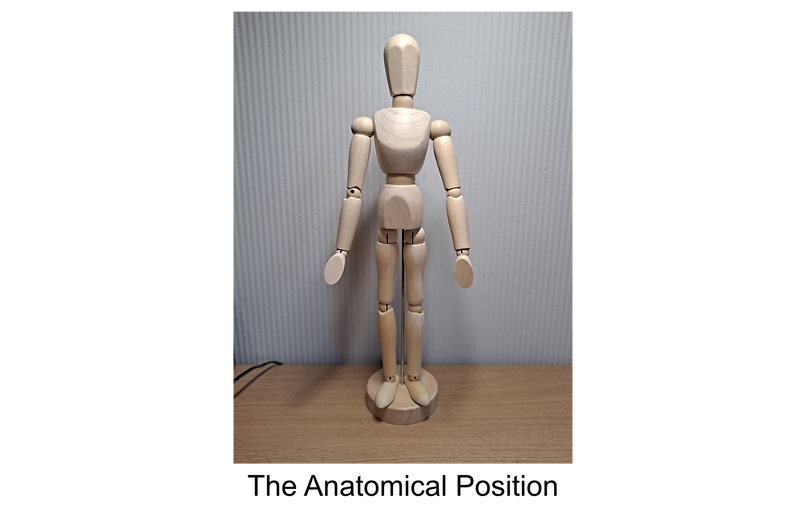
The Anatomical Position
Let’s look at the anatomical position first. The anatomical position is very particular and never changes. However, it can be easily visualised (or acted out). Imagine that you are looking directly at a human who is standing up straight and facing you. The head and eyes are both looking forwards, towards you. The arms of the human are close to his side, only slightly stretched to the sides. The palms of the hands are facing forwards, towards you. This means that the thumbs are pointing outwards. The feet are pointing forward and are touching each other at the heel, but not at the toes.
Precise positional anatomical terms
Now let’s look at the precise positional anatomical terms. Remember that these are relative, as mentioned in the first paragraph of this page. Note also that all of the terms have opposites. The main six terms that are used frequently are:
*See next section on body planes.
There are many more positional terms, and we will look at these in a little while.
Let's go back to the examples. Now, it shouldn’t matter to us if the human is standing, sitting or lying down because any terms we use refer to the human in the anatomical position. We can say that the heart lies anterior to the spinal cord. The spinal cord lies posterior to the heart. Also, the brain lies superior the stomach. The stomach lies inferior to the brain.
- Anterior – means ‘in front of’ when in the anatomical position.
- Posterior – means ‘behind’ when in the anatomical position.
- Superior – means ‘above’ when in the anatomical position.
- Inferior – means ‘below’ when in the anatomical position.
- Medial – means ‘closer to the midline*’ when in the anatomical position.
- Lateral – means ‘closer to the sides*’ when in the anatomical position.
*See next section on body planes.
There are many more positional terms, and we will look at these in a little while.
Let's go back to the examples. Now, it shouldn’t matter to us if the human is standing, sitting or lying down because any terms we use refer to the human in the anatomical position. We can say that the heart lies anterior to the spinal cord. The spinal cord lies posterior to the heart. Also, the brain lies superior the stomach. The stomach lies inferior to the brain.

Clinical Top Tip:
Related Video
Related Video
bottom of page