top of page

1.5. Reflex Arcs
What is a Reflex?
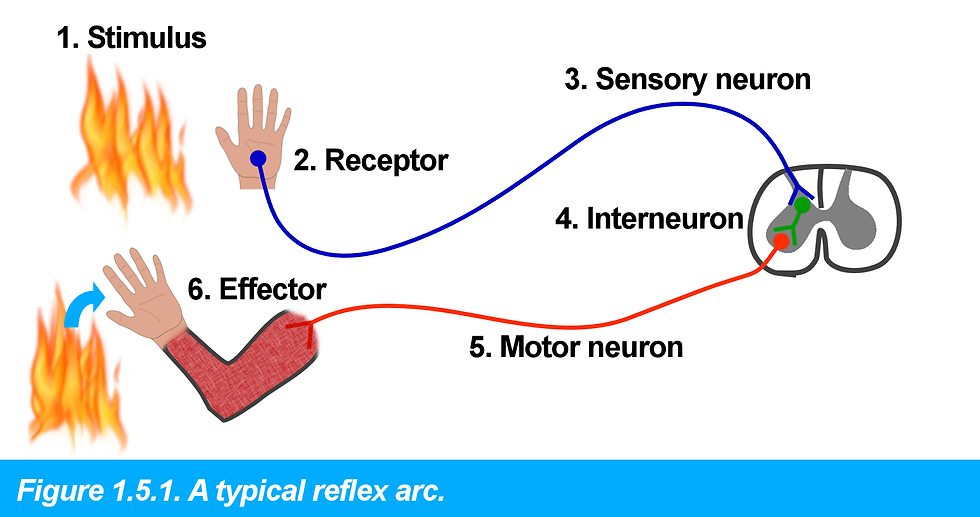
A reflex arc provides a great example to combine everything we have learned so far, such as neurons, the RMP, action potentials and synapses. A reflex arc is also a vitally important event in its own right. It functions to quickly protect the body from immediately threatening stimuli. Reflex arcs pass through the spinal cord but not the brain, which means that our response is rapid and involuntary. It would take a long time to consult the brain and consciously decide how to respond all threatening stimuli, and all the while potentially life-threatening damage would be occurring. So, the brain is bypassed and the spinal cord acts as the processing centre. The reflex arc is explained in writing and in Figure 1.5.1. *This example of a reflex arc shows only three neurons. Some reflex arcs will use more than three neurons.
The Six-Stage Response
1. Stimulus
A chef is working in a kitchen and accidentally places his hand on a hot surface. The high temperature of the hot surface is the stimulus.
2. Receptor
Temperature receptors in the skin of the hand detect the stimulus. The receptors respond by opening Na+ ion channels in the sensory neuron and an action potential is generated.
3. Sensory neuron
The action potential passes along the sensory neuron in the chef's arm. The action potential travels extra fast because the sensory neuron is myelinated, and the action potential ‘jumps’ along the axon. The action potential then reaches the chef’s spinal cord.
4. Interneuron
In the grey matter of the spinal cord, the sensory neuron synapses with an interneuron. This interneuron is short in length and so it quickly synapses with a motor neuron.
5. Motor neuron
The action potential travels along the motor neuron, which is myelinated, and leaves the grey matter of the spinal cord. It travels back down the chef’s arm, heading for the muscles in the upper arm.
6. Effector
The action potential in the motor neuron reaches a neuromuscular junction, releases a neurotransmitter and stimulates the biceps brachii and brachialis muscles in the arm to contract. This means the chef involuntarily moves his hand up and away from the stimulus, thereby reducing the amount of damage to the skin.
Note that many interneurons will also give off 'collateral axons' that run up to the brain for processing. This means that we have an initial involuntary reflex but slightly later we will have a voluntary response that is more complex and based on our understanding of the stimulus. In our example, this voluntary response might be the chef running his hand under cold water for ten minutes!
A chef is working in a kitchen and accidentally places his hand on a hot surface. The high temperature of the hot surface is the stimulus.
2. Receptor
Temperature receptors in the skin of the hand detect the stimulus. The receptors respond by opening Na+ ion channels in the sensory neuron and an action potential is generated.
3. Sensory neuron
The action potential passes along the sensory neuron in the chef's arm. The action potential travels extra fast because the sensory neuron is myelinated, and the action potential ‘jumps’ along the axon. The action potential then reaches the chef’s spinal cord.
4. Interneuron
In the grey matter of the spinal cord, the sensory neuron synapses with an interneuron. This interneuron is short in length and so it quickly synapses with a motor neuron.
5. Motor neuron
The action potential travels along the motor neuron, which is myelinated, and leaves the grey matter of the spinal cord. It travels back down the chef’s arm, heading for the muscles in the upper arm.
6. Effector
The action potential in the motor neuron reaches a neuromuscular junction, releases a neurotransmitter and stimulates the biceps brachii and brachialis muscles in the arm to contract. This means the chef involuntarily moves his hand up and away from the stimulus, thereby reducing the amount of damage to the skin.
Note that many interneurons will also give off 'collateral axons' that run up to the brain for processing. This means that we have an initial involuntary reflex but slightly later we will have a voluntary response that is more complex and based on our understanding of the stimulus. In our example, this voluntary response might be the chef running his hand under cold water for ten minutes!

Clinical Top Tip:
Related Video
Related Video
bottom of page